
Hybrid vs Off-Grid vs On-Grid Inverters: Which One Fits the Site?
The inverter decides what a solar system can do when the grid goes down, whether it needs batteries and how easily it can grow. Here is how the three types differ, plus the details that tend to catch people out after the order is placed.
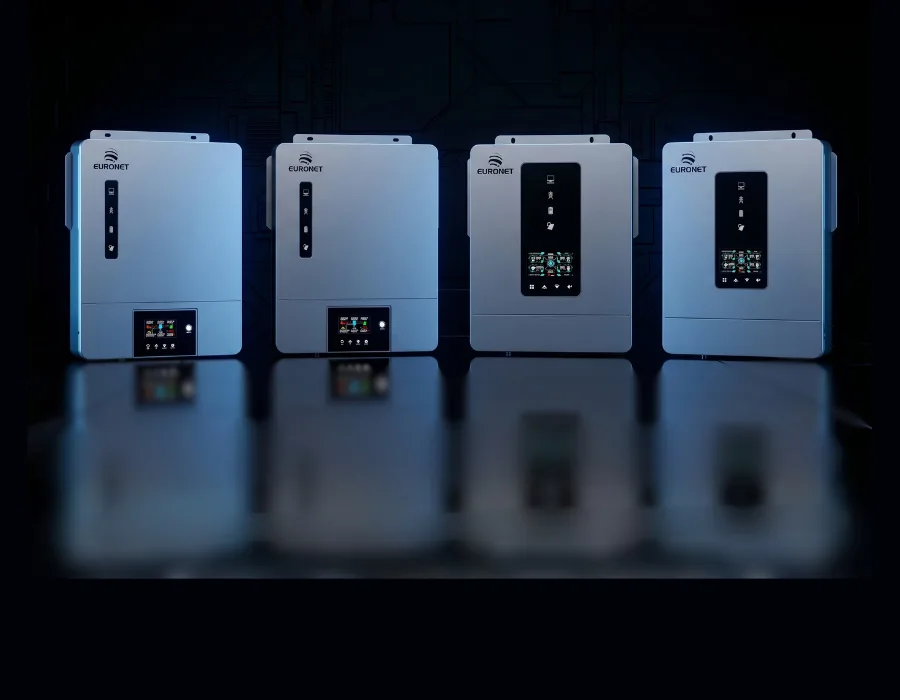
The Three Types in One View
On-grid (grid-tie)
No batteries
Turns solar power into AC for the building and works alongside the grid. When the grid fails it shuts down by design, so there is no backup.
- Lowest cost per kW
- Best where the grid is stable
- Usually needs utility approval
Off-grid
Batteries, no grid connection
Runs the site from panels and batteries alone, often with a generator as a fallback. Many models can also take a generator or grid supply as a charger.
- For farms, rural homes and remote sites
- Battery sized for night and cloudy days
- No export to the grid
Hybrid
Batteries and grid
Combines both. It powers loads from solar first, stores the surplus in batteries and keeps running from the battery when the grid goes down.
- Backup during outages
- Can prioritise solar, battery or grid
- Easiest to expand later
On-Grid: The Cheapest Option, With No Backup
A grid-tie inverter matches the grid's voltage and frequency and feeds solar power into the building's supply. Whatever the building does not use can flow back to the grid where the rules allow it. The catch is safety. To protect line workers, a grid-tie inverter must stop when the grid fails, a feature called anti-islanding. So during an outage the panels sit idle, even on a sunny afternoon. That makes on-grid systems a good fit where power is reliable and the aim is a lower bill, as in most of the UAE and Saudi Arabia. Grid-connected systems there go through the local utility's approval process, such as Shams Dubai with DEWA, and usually require approved equipment. In places with daily outages, an on-grid system on its own rarely makes sense.
Anti-islanding
Grid-tie inverters switch off when the grid fails
Off-Grid: Full Independence, Sized for the Worst Day
An off-grid inverter builds its own AC supply from a battery bank, which the panels recharge through an MPPT or PWM charge controller, often built into the inverter. With no grid to fall back on, the battery has to carry the night and ideally a cloudy day or two, and the array has to refill it in the hours the sun allows. That makes off-grid systems larger and dearer per kW than grid-tied ones. On a farm or rural site with no connection, though, the real comparison is with diesel, not with the grid. Many off-grid inverters accept a generator input, so a small generator can top up the batteries after a long cloudy spell instead of running all day.
Sized for autonomy
Night load plus a cloudy-day reserve
Hybrid: The Usual Choice Where Outages Are Common
A hybrid inverter does both jobs. While the grid is up it can run the building from solar, charge the batteries and, where allowed, export the surplus. When the grid drops it carries on from the battery and panels. Most let you set the priority. Solar first, then battery, then grid keeps bills lowest. Keeping the battery full and drawing on the grid during the day suits sites that care most about backup. Time-of-use settings help where tariffs change through the day. Can a hybrid inverter work without a battery? Many can, running like a grid-tie unit until a battery is added. Some models, though, need a battery connected to start up or to power loads, so check the datasheet before selling one as battery-ready. For homes and small businesses in Nigeria, Sudan and other markets with regular load-shedding, a hybrid inverter with lithium storage is usually the right design.
Priority modes
Common settings on hybrid inverters
Order of supply
- Solar, battery, gridLowest bills
- Solar, grid, batteryBattery kept for outages
- Time of useWhere tariffs vary
Single-Phase or Three-Phase?
Many villas in the Gulf, and larger homes and shops in Nigeria, have a three-phase supply. A single-phase inverter in a three-phase building can only back up the circuits on its own phase. That is fine if the essential loads are grouped there, and a problem if they are spread across all three. A three-phase hybrid inverter supplies all three phases and can run three-phase motors such as larger pumps and compressors. If the building is three-phase and the customer wants whole-house backup, it is usually simpler than rewiring loads onto one phase.
Check the supply first
A single-phase inverter backs up one phase only
Low-Voltage or High-Voltage Batteries?
Hybrid inverters are built for one of two battery types. Low-voltage (LV) systems use 48 V batteries, nominally 51.2 V for lithium. High-voltage (HV) systems stack modules in series to reach a few hundred volts. LV batteries are simpler to handle and to add to, and they suit most homes. HV systems run at much lower current for the same power, so cables are thinner and losses smaller, which pays off on larger three-phase installations. The two are not interchangeable: an LV inverter cannot use an HV battery, and the reverse is also true. In the EURONET range, the Edge Series three-phase hybrid inverters work with 48 V batteries, while the Ultra Series is designed for high-voltage storage.
Not interchangeable
Match the battery to the inverter
Before You Order, Check
- Rated output power in kW, not only the kVA figure
- Surge rating against the largest motor on site
- Pure sine wave output, which inverter air conditioners, pumps and electronics need
- MPPT voltage range and number of trackers against your panel strings
- Battery voltage (LV or HV) and BMS communication with your battery brand
- IP rating if it will be mounted outdoors or in a dusty area
- How much output drops at high ambient temperatures
Common questions
Can a hybrid inverter work without a battery?
Many can, working like a grid-tie inverter until a battery is fitted. Some models need a battery to start up or to supply loads, so check the datasheet.
What is the difference between pure sine wave and modified sine wave?
A pure sine wave inverter produces the same smooth waveform as the grid. A modified sine wave inverter produces a stepped version that is cheaper to make. It runs lights and simple heating loads, but motors run hotter and noisier on it, and some electronics and inverter-type air conditioners may not work properly.
Is a bigger inverter always better?
No. An inverter far larger than the load uses some energy just staying on, and it costs more. Size it about 25% above the realistic peak, with a surge rating that covers motor start-up. Our sizing guide shows how.
Can I export solar power to the grid in the UAE or Saudi Arabia?
Approved grid-connected systems can, under schemes such as Shams Dubai and Saudi Arabia's small-scale solar PV regulations. Approval comes through the local utility, and the equipment usually has to meet its requirements.
Related guides
Not sure which inverter fits?
Share the site's supply type, loads and outage pattern, and our team will recommend an inverter from the EURONET range.