
Solar Water Pump Sizing: Head, Flow & How Many Panels
A solar pump that is too small leaves the tank half empty by evening. One that is too big can pull a borehole dry. Sizing comes down to three numbers: how much water you need, how high it has to go and how much sun the site gets.
Three Numbers to Collect First
- 01
Daily water need
Work in cubic metres a day (1 m³ is 1,000 litres). For irrigation, 1 mm of water over one hectare is 10 m³, so a crop needing 5 mm a day on one hectare needs about 50 m³ daily. For livestock, use local guidance per animal, and allow for much higher demand in hot weather.
- 02
Total dynamic head
The full height the pump has to lift, plus losses: the depth to the water level while pumping, the height from the ground to the top of the tank, and friction in the pipe.
- 03
Source yield and sun
Check how much water the borehole can supply per hour without the level dropping too far, from the drilling or test-pumping report. Then find the site's peak sun hours.
Working Out Total Dynamic Head
Head is where most pump sizing goes wrong, usually because someone uses the borehole depth instead of the water level. Total dynamic head = pumping water level + height to the tank inlet + friction losses The pumping water level is the static water level plus drawdown, the extra drop once the pump starts. A borehole drilled to 120 m might have water at 40 m that falls to 50 m when pumping. If the tank stands 6 m above ground and friction adds 4 m, the total dynamic head is 60 m. Friction depends on pipe diameter, length and flow. On long runs, going up one pipe size often saves more energy than the extra pipe costs. A common target is to keep friction below about 10% of the total head.
60 m
Total dynamic head in the example
Pumping water level
Tank height
Friction losses
From Water to Watts
Lifting one cubic metre of water by one metre takes about 2.725 Wh of energy. That gives a simple formula for the energy the water itself needs each day: Hydraulic energy (Wh/day) = 2.725 × daily volume (m³) × total dynamic head (m) No pump is perfectly efficient, so divide by the efficiency of the pump and motor together. For small and medium solar pump sets, 40% is a cautious working figure, and the pump curve on the datasheet gives the real value at your duty point. Then divide by peak sun hours and allow for heat and dust losses on the panels. For 20 m³ a day at 60 m head with 5.5 peak sun hours: 2.725 × 20 × 60 = 3,270 Wh of hydraulic energy. Divided by 0.4, that is about 8,200 Wh of electrical energy. Divided by 5.5 sun hours and a 0.8 loss factor, it comes to about 1,860 W. So the site needs around 1.9 to 2 kW of panels, driving a pump whose curve delivers roughly 20 m³ over the day at 60 m.
≈ 2 kW
Panels for 20 m³ a day at 60 m head
DC Pump, or AC Pump With a Solar Pump Inverter?
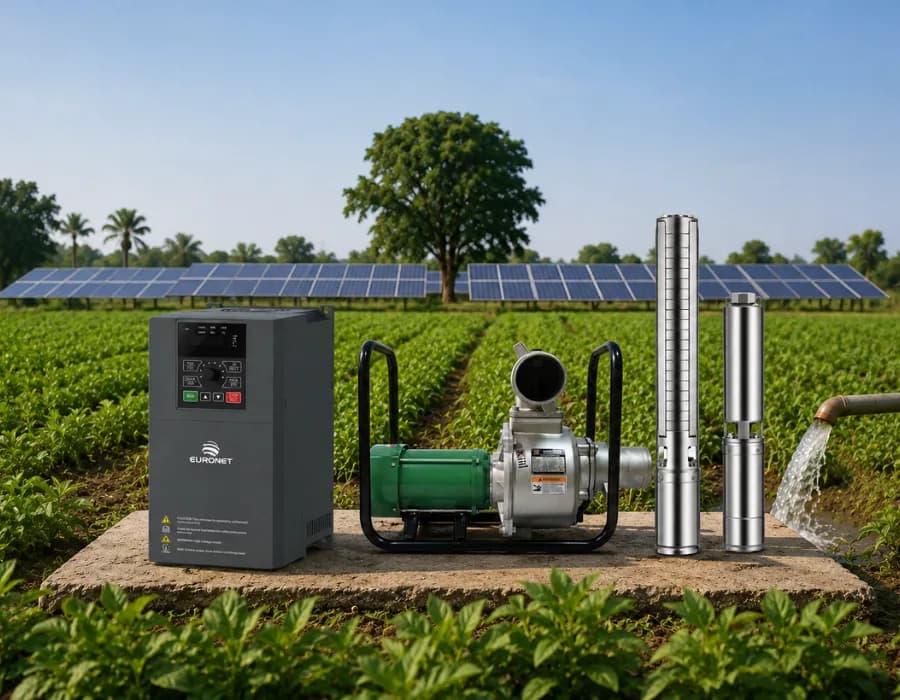
DC solar pumps, usually with brushless motors, run directly from the panels through a controller. They are efficient at small to medium flows and suit boreholes, small farms and livestock watering. EURONET's DC submersible pumps come in versions for 50, 80, 120 and 200 m of head, alongside 2, 3 and 4 inch DC surface pumps. For larger flows, a standard AC pump driven by a solar pump inverter is often the better route. The inverter turns panel output into variable-frequency AC and slows the pump as the sun weakens instead of stopping it. It also lets a farmer solarise an existing AC submersible rather than replace it, and some models accept grid or generator input as well. EURONET solar pump inverters run from 1.5 kW single-phase up to 30 kW three-phase.
Rough guide
Which pump type suits which source
- Small flows from a deep boreholeDC submersible
- Shallow source, under 7 m suctionDC surface pump
- Large flows or an existing AC pumpSolar pump inverter
Surface or Submersible?
A surface pump sucks water up to itself, and physics limits how far. In practice a surface pump can draw from about 7 m below it at sea level, and less at altitude. Beyond that the pump has to go down into the water, which means a submersible. Surface pumps suit rivers, canals, ponds and shallow wells, and they are handy for pushing water from a tank out to drip lines. Submersibles handle boreholes and deep wells, and they run cooler because water flows around the motor.
≈ 7 m
Practical suction limit for a surface pump at sea level
Store Water, Not Electricity
Most solar pumping systems have no batteries. The tank does the storing: pump while the sun is up and let gravity feed the field or the trough the rest of the time. A tank holding two to three days of water covers cloudy spells on most farms. Add a float switch so the pump stops when the tank is full, and a dry-run sensor or well probe so it stops if the water level falls too low. Both cost little compared with a burnt-out motor.
No batteries needed
The tank is the storage
Common questions
How many solar panels do I need for a 1 HP pump?
A 1 HP motor is about 746 W. Installers typically fit an array of about 1.3 times the pump's rated power, so roughly 1 kW of panels, and a little more in hazy or dusty areas. The pump and controller maker's recommendation is the final word.
Can a solar pump run at night?
Not directly. Either pump into a tank during the day, or add batteries or a grid or generator supply. A storage tank is almost always the cheaper option.
What size pump do I need for my borehole?
Start from the borehole's tested yield and pumping water level. The pump should never take more water per hour than the borehole can recharge, and its curve has to deliver your daily volume at your total dynamic head.
How much water does drip irrigation need per hectare?
It depends on the crop, season and climate. As a working figure, 1 mm of water over one hectare is 10 m³, so crops needing 4 to 6 mm a day use roughly 40 to 60 m³ per hectare daily. Local agricultural extension data gives the best figures for a specific crop.
Related reading
Planning a solar pumping project?
Send us the borehole report, the daily water need and the site location. Our team will match a pump, controller and panel array from the EURONET range.