
How to size a solar system: Inverter, Batteries & Solar Panels
The usual mistake is choosing the inverter first and fitting everything else around it. It works better the other way round: start with the loads. This guide covers the four numbers you need, in the order installers work them out, with a worked example for a typical home.
kVA and kW are not the same number
Inverters in Nigeria and much of Africa are usually sold by kVA, while appliance labels and datasheets talk in watts. kVA is apparent power. kW is the real power your appliances can draw. The link between them is the power factor: kW = kVA × power factor. Many inverters are designed around a power factor of 0.8, so a 5 kVA unit delivers about 4 kW continuously. Newer models often run closer to 1.0, which means a 5 kVA unit may give the full 5 kW. The only way to know is the rated output power on the datasheet, so check that line before you size anything around the figure printed on the box.
kW = kVA × PF
Always confirm the rated output power on the datasheet
A 5 kVA inverter gives
at power factor 0.8
at power factor 1.0
The four steps, in order
- 01
List your loads
Write down every appliance you want on solar, its wattage and how many hours a day it runs. Multiply watts by hours to get watt-hours (Wh) per day and add them up. For fridges, the yearly kWh on the energy label divided by 365 is more accurate than the wattage.
- 02
Find your peak load
Add up everything that might run at the same moment. That figure, plus room for motors starting, sets the inverter size. Fridges, pumps and non-inverter air conditioners can draw several times their running power for a second or two at start-up.
- 03
Size the battery bank
Decide how many watt-hours you need from storage, usually the evening and night load. Then allow for how deeply that battery type can be discharged and for inverter losses.
- 04
Size the solar array
The panels have to cover the daytime load and refill the battery. That depends on your daily energy use and on how many peak sun hours your location gets.
Steps 1 & 2: Loads and Inverter size
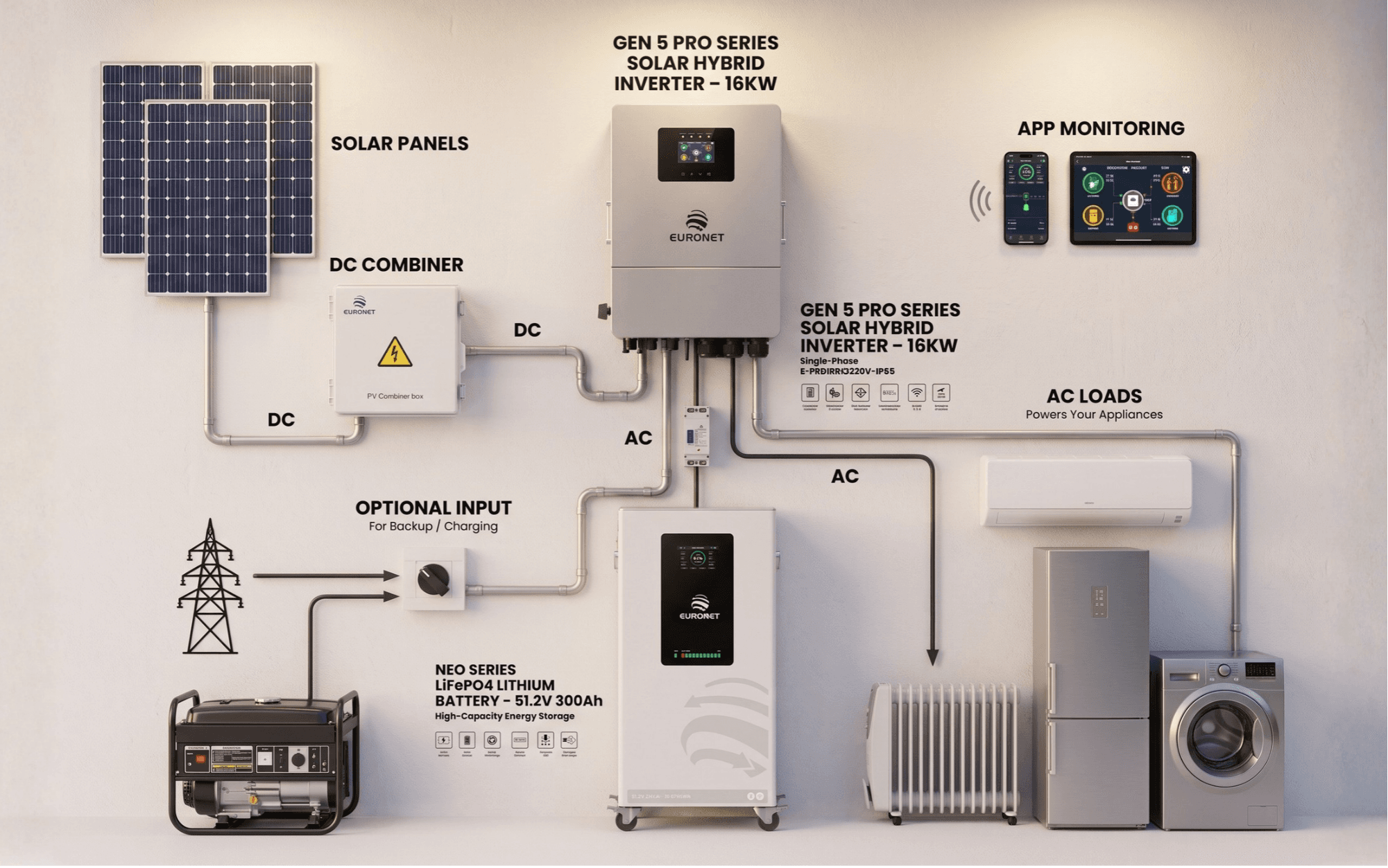
Take a three-bedroom home with frequent grid outages. Lighting at 150 W for 6 hours is 900 Wh. A fridge-freezer averages about 1,000 Wh a day. Two TVs and a decoder at 250 W for 5 hours add 1,250 Wh. Four fans at 75 W each for 8 hours use 2,400 Wh, and laptops, phones and the router take roughly 600 Wh. That comes to about 6,150 Wh a day. The peak is far lower than the sum of every rating, because not everything runs at once. Lights, fridge, TVs, fans and a laptop together draw around 1 kW. Switch on a 1 HP inverter-type air conditioner as well and the peak goes to roughly 2 kW. Note that the air conditioner's energy is not in the 6,150 Wh. Running one for several hours a night changes the battery maths a lot, so decide early whether it goes on the solar circuit. A good rule is to choose an inverter whose continuous rating is at least 25% above your realistic peak, with a surge rating that covers the largest motor starting. For this house a 3 kW inverter handles the load, air conditioner included. A 5 kW unit makes sense if a second air conditioner or a water pump is likely later. EURONET's Pro IP65 hybrid inverters come in 3, 6, 10 and 16 kW, which covers most homes and small shops.
Example home
Three bedrooms, frequent outages
Daily use without AC
Realistic peak with one AC
Inverter size with margin
Step 3: How Many Batteries You Need
Start with the energy you need from storage, not the whole daily figure. If the grid or the sun covers the daytime, the battery only has to carry the evening and night. In our example that is about 4,000 Wh. Two corrections come next. First, inverter losses: divide by about 0.9. Second, depth of discharge. Lithium iron phosphate (LiFePO4) batteries are commonly used to 80–90% of their capacity, while lead-acid, tubular and gel batteries last much longer if you keep them around 50%. For lithium: 4,000 ÷ 0.9 ÷ 0.8 ≈ 5,600 Wh of battery capacity. For lead-acid: 4,000 ÷ 0.9 ÷ 0.5 ≈ 8,900 Wh. Then match the battery voltage to the inverter. A 48 V inverter needs four 12 V batteries in series and a 24 V inverter needs two. Four 12 V 200 Ah batteries in series give 48 V and 200 Ah, or 9,600 Wh, which covers the lead-acid case above. On the lithium side, a single 48 V module of about 5 kWh would fall slightly short, so a 10 kWh bank or two smaller modules in parallel is the safer choice.
Series wiring
12 V batteries needed per string
By inverter voltage
- 12 V inverter1 battery
- 24 V inverter2 batteries
- 48 V inverter4 batteries
Step 4: How Many Solar Panels
Divide the daily energy the panels must supply by your peak sun hours, then allow for real-world losses from heat, dust, wiring and the charge controller. A factor of 0.75 is a reasonable starting point in hot, dusty climates. Peak sun hours vary more than people expect. Coastal southern Nigeria often averages around 4 to 4.5 a day, while northern Nigeria, Saudi Arabia and the UAE are usually above 5.5. Free tools such as the Global Solar Atlas give the figure for any site. For the example home in Lagos: 6,150 Wh ÷ 4.5 ÷ 0.75 ≈ 1,820 W. Rounded up, that is about 2 kW of panels, for instance four or five modules in the 400 to 550 W range, depending on how they fit the inverter's input. That last part matters. Each string's voltage has to stay inside the inverter's MPPT window on both the hottest and the coolest days, because panel voltage drops as temperature rises. The inverter and panel datasheets give you the limits.
≈ 2 kW
of panels for the example home
The worked example at a glance
Inverter
3 kW hybrid
Covers a peak of about 2 kW with one air conditioner running, plus 25% headroom.
Battery bank
≈ 5.6 kWh lithium or 9.6 kWh lead-acid
Carries about 4 kWh of evening and night load at a safe depth of discharge.
Solar array
≈ 2 kW of panels
Based on 4.5 peak sun hours and a 0.75 loss factor.
Sizing mistakes to avoid
- Sizing the inverter from the kVA on the box without checking its real output in kW
- Forgetting the start-up current of fridges, pumps and air conditioners
- Planning lead-acid batteries for 80% discharge every night
- Mixing old and new batteries, or different battery types, in one bank
- Panel strings whose voltage drifts outside the MPPT range in summer heat
- Mounting the inverter in direct sun, where it cuts its output to protect itself
Common questions
How many batteries do I need for a 5 kVA inverter?
Many 5 kVA inverters run at 48 V, so the minimum is four 12 V batteries in series. Whether four is enough depends on your load. Four 200 Ah batteries store 9.6 kWh, of which about 4.8 kWh is usable if you keep lead-acid at 50% discharge. For more backup, add a second string of four or move to lithium.
What can a 3.5 kVA inverter carry?
Usually about 2.8 to 3.5 kW continuously, depending on its power factor. That runs lights, fans, TVs, a fridge, laptops and a small inverter-type air conditioner if little else is on. Large non-inverter air conditioners, pumps, irons and kettles take it close to its limit.
Can I add more batteries later?
With lithium, usually yes, as long as the model supports parallel modules and you add the same type. With lead-acid it is better to install the full bank at once, because a new battery wired next to old ones soon ages to match the weakest.
Do I need a hybrid inverter?
If you want solar to keep the power on during outages and also cut your bill while the grid is up, a hybrid inverter is the simplest route. Our guide to hybrid, off-grid and on-grid inverters explains the differences.
Related guides
Want us to check your sizing?
Send us your load list and location. Our technical team will suggest an inverter, battery and panel combination from the EURONET range.